I, GPU
The story of the modern GPU in first person, tracing its journey from raw minerals and global supply chains to the heart of the AI economy. Inspired by I, Pencil, by Leonard Read.

Over the last few years, the GPU has gone from being a niche computing component to a household term. GPU shortages have shaped news cycles, startups raise billions to secure compute access, nations compete over semiconductor supply chains, and some of the world’s most valuable companies now revolve around the ability to design, manufacture, or deploy these chips at scale.
Although the GPU often appears to us as a single object: a card inside a machine, a product with a price tag, a benchmark score, or a line item in a data center budget; it represents one of the most complex industrial artifacts ever created.
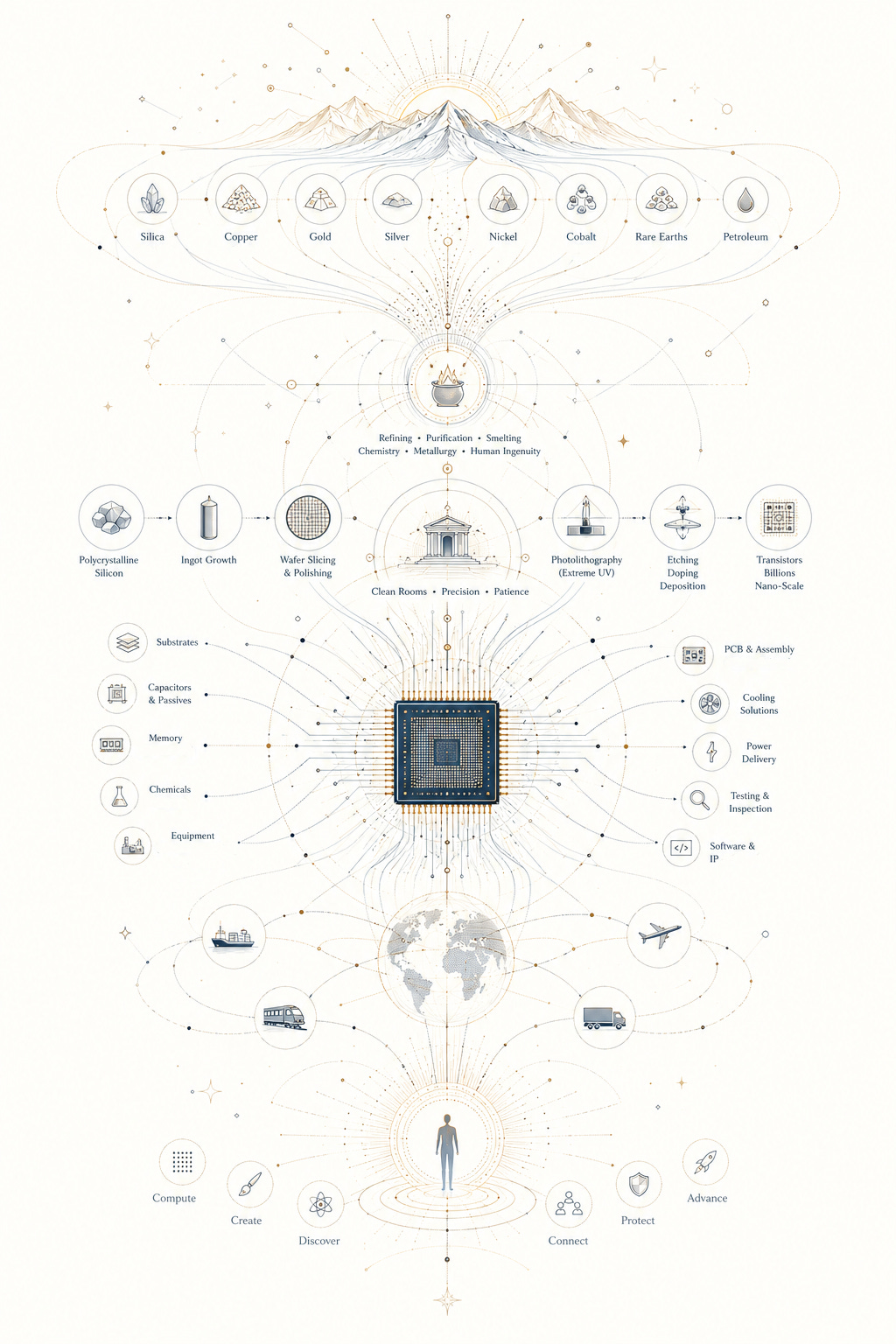
Behind every GPU lies an extraordinary web of coordination spanning miners extracting silica, copper, cobalt, and rare earths; chemists refining materials to atomic purity; engineers designing lithography systems; factories operating at nanometer precision; container ships crossing oceans; power grids sustaining fabrication plants; and software developers writing layers of invisible code that make modern computation possible.
Reading about what it takes to build a GPU reminded me of I, Pencil by Leonard E. Read, where an ordinary pencil narrates the immense network of human collaboration required for its existence. Inspired by Read’s essay, and written with substantial assistance from AI systems themselves, this poem attempts to trace the journey of the modern GPU, from buried minerals to machine intelligence.
I present: I, GPU.
I, GPU
I am no solitary machine.
No clean monolith etched in silicon glory,
No artifact born whole
From the immaculate white rooms of NVIDIA
Or Advanced Micro Devices.
I am a parliament of earths,
A treaty signed across continents,
A cathedral of extraction, chemistry, logistics, mathematics, and power.
You know me by teraflops.
By frames rendered, tokens predicted,
Worlds simulated, proteins folded.
But long before your benchmarks and leaderboards,
I began buried beneath mountain and desert.
Part of me slept
In quartz veins under Brazil,
Where silica waited through geological epochs
To become the wafers upon which thought would later travel.
Part of me lay in copper ores
Dragged from the pits of Chile,
Where men, trucks, crushers, acids, and smelters
Turned ancient rock into conductive arteries.
Gold came quietly from many lands,
Threaded eventually into contacts thinner than intention itself.
Silver crossed oceans.
Nickel hardened my resolve.
Tin waited to become solder.
Palladium guarded corrosion.
Cobalt journeyed from the deep scars of Democratic Republic of the Congo,
Passing through traders, refiners, exchanges, insurers, ports,
Until morality itself became difficult to trace.
Rare earths emerged from poisoned lakes and refineries,
Neodymium, dysprosium, lanthanum,
Names few consumers speak
Yet without which precision collapses.
I owe debts to petroleum too.
Hydrocarbons cracked into plastics,
Into epoxy resins, laminates, photoresists, insulation, packaging foams,
The soft black skeleton surrounding my metallic nerves.
Do not mistake me for “digital.”
I am profoundly physical.
My beginnings pass through furnaces hotter than volcanoes.
Silicon purified again and again,
Until impurities shrink to parts per billion,
For electrons are aristocrats,
Intolerant of disorder.
Gigantic crystal ingots rise slowly from molten baths,
Like artificial stalagmites grown by mathematics.
Diamond saws slice them into wafers.
Polishers smooth them to near-perfection,
For even microscopic unevenness
Would become computational failure.
Then come the temples humans built for precision.
Factories where the air is cleaner than operating rooms.
Where yellow light protects chemistry.
Where vibrations from distant footsteps matter.
Where entire buildings exist
To stop a speck of dust.
There, machines made by ASML
Project impossible geometries with extreme ultraviolet light,
Generated through droplets of tin struck by lasers
Thousands of times each second.
German optics,
Dutch engineering,
American software,
Japanese chemicals,
Taiwanese fabrication,
Korean memory,
Global dependency compressed into nanometers.
Layer upon layer,
Deposition, etching, doping, implantation.
Atoms rearranged with such violence and precision
That logic itself becomes architecture.
I become billions of transistors,
Each smaller than a virus,
Switching endlessly between yes and no,
Certainty and absence,
Voltage and silence.
But I am not yet whole.
I travel encased in foam and nitrogen,
Insured by London financiers,
Tracked by satellites,
Loaded by cranes in ports humming through midnight.
Substrates arrive from one nation.
Capacitors from another.
Memory from fabs in South Korea.
Cooling systems from factories in China.
Firmware written by engineers scattered across time zones
Who may never meet the miners who began this story.
Container ships move me across oceans,
Burning bunker fuel beneath constellations older than civilization.
Railways carry me inland.
Warehouses barcode me into inventory abstractions.
Algorithms forecast my demand before humans themselves understand it.
Then assembly.
Robotic arms place components with sub-millimeter precision.
Solder liquefies and hardens.
Boards pass through inspection cameras
That search for defects invisible to human sight.
At last, I awaken.
A current flows.
Fans spin.
Heat rises.
Firmware speaks.
Benchmarks begin their rituals.
Humans call this “artificial intelligence,”
Yet I contain millions of deeply human acts.
The miner descending underground before sunrise.
The chemist calibrating purity.
The sailor crossing typhoon routes.
The lithography engineer debugging photons.
The warehouse worker scanning pallets at 3 a.m.
The line operator replacing a defective capacitor.
The programmer optimizing kernels no consumer will ever see.
No central planner knows all of them.
No single government commands the totality of my existence.
No one mind comprehends the full procession required to create me.
And yet I emerge.
I train your models,
Render your films,
Simulate your molecules,
Mine your cryptocurrencies,
Guide your missiles,
Power your startups,
Feed your ambitions of abundance and autonomy.
You call me advanced technology.
But I am also geology,
Shipping law,
Colonial history,
Trade agreements,
Energy grids,
Labor markets,
Currency systems,
Industrial espionage,
Patent wars,
And the accumulated memory of civilization.
Disconnect one nation,
One chokepoint,
One refinery,
One shipping lane,
One fabrication node,
And my existence trembles.
For I am not merely a chip.
I am globalization rendered into silicon.